THIS IS WHO
I AM NOW

A guided journal to understand your patterns and practice change

This Is Who I Am Now is a guided journal. It provides questions and space to answer them in writing, in your own words.

Putting your answers on paper gives you time to pause, consider what you mean, and put feelings into words. You can revisit a thought, add something you initially overlooked, or notice a connection as you write.

Your answers also become a record you can return to. It can help to recognize a recurring pattern, to remember useful insights, and to see how your perspective changes over time.

Get the workbook on Amazon
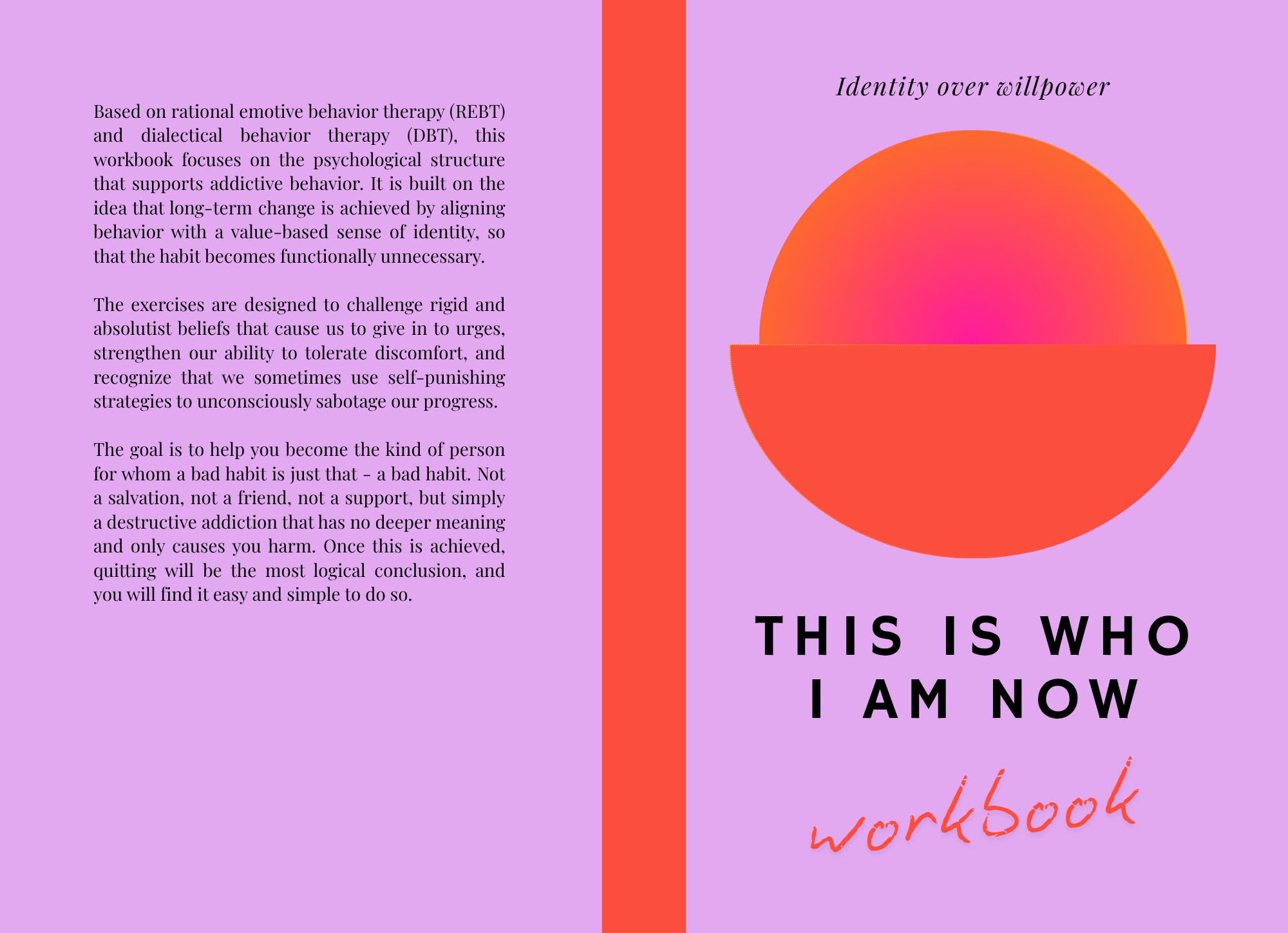
This Is Who I Am Now workbook cover in lilac and red, with the words Identity over willpower.

Understand what keeps you feeling stuck

Across ten sections, this guided journal invites you to explore your thoughts, emotions, values, and boundaries. Each section helps you turn what you discover into something you can change.

Reflecting on specific areas of your life can help you understand what keeps you stuck. What feels like a lack of discipline may involve fear, unmet needs, or difficulty saying no. Recognising these patterns and treating yourself with more forgiveness can make it easier to take a small step forward.

Self-guided practice, at your own pace

The workbook draws on ideas and skills from Rational Emotive Behavior Therapy (REBT) and Dialectical Behavior Therapy (DBT).

New to journaling? Here’s how to start

You don’t need journaling experience to open this workbook. The prompts give you a starting point, and the pages give you room to answer.

  1. Read the explanation. Get familiar with the idea behind the exercise.
  2. Write in your own words. A few honest sentences are enough to begin.
  3. Return when you’re ready. Give yourself time to reflect, practice, and notice what changes.

Your answers are yours to keep. No one is going to judge.

A few journaling questions from the workbook

Explore the rules you live by

Internal rules such as “Be strong” or “Please others” can make it difficult to rest or express your needs. The workbook calls these rules drivers and asks:

“Write about what your driver forbids and what your habit permits.”

Understand what makes change difficult

A habit may offer comfort, escape, connection, or a familiar routine. Before exploring a different response, consider what you fear losing:

“What is the hardest part about imagining life without your habit?”

Take the pressure off perfectionism

After identifying something you have postponed because you feel you must do it perfectly, imagine a version you could begin:

“What would a good enough version of that action look like?”

Give yourself room to learn

After practicing how to observe an urge without immediately acting on it, reflect on how you judge your efforts:

“What would it mean to approach this as a skill you're building rather than a test you're passing or failing?”

A meaningful gift for yourself from the Future You, with love

Picture the person you're becoming, reaching back to take your hand. They remember this exact moment, when you’ve decided to take control, despite not being sure that it will all work out. This journal is their gift to you.

On the days it feels hard, remember that the Future You is rooting for you. They're reaching back to remind you that you're not doing this alone.

Be kind to the you that is. Be curious about the you who is coming.

This Is Who I Am Now offers you this possibility to understand what you feel, what you need, and what you want to change. It also shows you that it is indeed possible to make that change. You were always capable of doing it, you just needed the right tools, some guidance and lots of love and compassion for yourself.

Testimonials

It treats personal growth like a skill you practice, which makes you understand that it's ok if it's not perfect the first time you try to take a different path. It handles tough topics like shame gently, making it safe to grow without being too hard on yourself.

If you want a fresh start but don't know where to begin, this notebook gives you an excellent starting point! It breaks this big problem you are unable to solve into small, manageable ones and it makes you realize that you can actually do it now. You don't need to regret what you did or ruminate forever about what you should have done years ago.

I've used this workbook when I decided to stop smoking. It really helped, especially the urge surfing part!

Originally made for addiction recovery, it is a great supplement to therapy. I personally used it to help me manage my binge eating disorder.

Meet yourself where you are. Stay curious about where you could go.

Start with one small change. See where it takes you.

Get This Is Who I Am Now on Amazon

This Is Who I Am Now — A guided journal for self-reflection and personal growth.

Frequently asked questions

Who is this guided journal for?

Whether you’re struggling with smoking, binge eating, or another behavior, you may recognise shared feelings, triggers, or ways of seeking comfort. It’s for anyone who wants to understand themselves better and explore habits they find difficult to change. The workbook focuses on addiction and recovery, alongside familiar struggles such as perfectionism, avoidance, people-pleasing, and self-criticism.

Do I need journaling experience?

No. You’ll find explanations, examples, and questions to help you begin. Write in your own words, without worrying about getting it right. A few honest sentences are a good place to start.

What kinds of exercises are inside?

You’ll explore what matters to you, what you feel, and what you need. Some exercises help you question harsh beliefs about yourself. Others invite you to practice saying no, ask for support, try a new routine, or write a letter to your future self.

How does it use REBT and DBT?

The workbook draws on two therapy approaches and introduces their ideas through explanations, examples, and exercises.

Rational Emotive Behavior Therapy (REBT) helps you explore beliefs that put pressure on you, such as “I must never make mistakes” or “I can’t handle this feeling.” You’ll practice questioning these beliefs and finding more flexible responses: “I’d like to do well, but making a mistake doesn’t define my worth.”

Dialectical Behavior Therapy (DBT) brings together acceptance and change. You can acknowledge that something feels difficult while learning how to respond differently. The workbook includes exercises for naming emotions, grounding yourself during distress, accepting what you cannot change, and communicating your needs and boundaries.

You don’t need to know any therapy terms before you begin. Just bring a pen and an open heart, and this journal will guide you through every step.
Should I work through the chapters in order?

Yes. The chapters build on one another, so you should start at the beginning.

How long does it take to complete?

There’s no deadline. The journal includes around 240 questions across ten chapters (229 pages). Some invite you to sit and write, while others ask you to try something over several days or a week. Give yourself time to reflect and practice at a pace that feels manageable.

Can I use it alongside therapy?

Yes. This journal can be a helpful companion to therapy, giving you space to reflect between sessions. Its questions can help you put feelings into words, notice patterns in everyday life, and remember things you’d like to discuss with your therapist.

You can also return to your answers together, explore what feels difficult, and consider which exercises support the work you’re already doing. Share as much or as little as you feel comfortable with. Your writing belongs only to you.